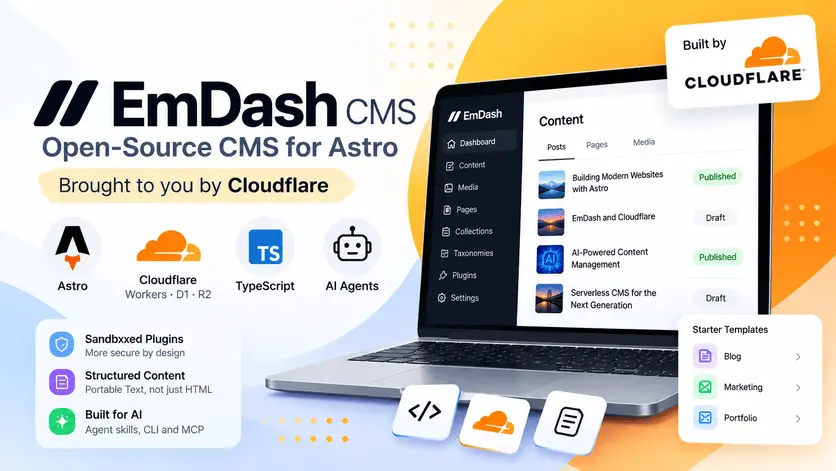
EmDash is a modern open-source CMS built on Astro and Cloudflare, bringing WordPress-style content management, extensibility, sandboxed plugins, structured content, and AI-ready tools to a modern TypeScript stack.
EmDash CMS: Is It Really a WordPress Killer?
You may have seen people describe EmDash CMS as a "WordPress killer." It's an interesting comparison, but that doesn't necessarily mean EmDash is trying to replace WordPress.
EmDash is an open-source, full-stack TypeScript CMS built on Astro. It takes ideas that made WordPress popular, such as content management, an admin experience, extensibility and plugins, and approaches them using modern web technologies.
For developers who prefer Astro, TypeScript and modern cloud infrastructure, EmDash offers a different way to build CMS-powered websites.
Why Is EmDash Being Compared With WordPress?
The comparison is understandable because both platforms provide many of the things developers expect from a modern CMS: content management, an administration interface, media management, custom content types, authentication and plugins.
The major difference is the technology underneath.
WordPress is built around the PHP ecosystem, while EmDash is built with TypeScript and Astro. EmDash also takes a modern approach to structured content, plugin security and AI-assisted development.
That doesn't make one platform automatically better than the other. They are designed around different development approaches.
WordPress Still Has a Huge Advantage
WordPress has been developed and improved for many years and has an enormous ecosystem behind it.
There are thousands of plugins and themes, a huge developer community, extensive documentation and almost every type of hosting environment you can imagine.
If you're already comfortable with PHP and WordPress, there is a good reason to continue using it. An existing WordPress website with a working theme, plugins and established workflow doesn't suddenly need to move to another CMS.
EmDash is more interesting when you're starting something new and want to work with a modern TypeScript and Astro stack.
EmDash and Cloudflare
One of the interesting things about EmDash is that it is brought to you by Cloudflare. This makes Cloudflare a natural environment for running EmDash, particularly because EmDash can make use of services such as Workers, D1, R2 and KV.
However, EmDash is not locked to Cloudflare.
This is an important distinction. The project uses portable abstractions so developers can use different infrastructure depending on their requirements.
For example, the database layer can use Cloudflare D1, but EmDash can also work with SQLite, Turso/libSQL and PostgreSQL.
For storage, Cloudflare R2 is supported, but EmDash can also work with AWS S3, other S3-compatible storage and local filesystems.
The same idea applies to sessions and plugins. Sessions can use Cloudflare KV, Redis or file-based storage, while plugins can run in sandboxed Cloudflare Worker isolates or in a sandboxed workerd child process.
In other words, Cloudflare provides a particularly well-integrated environment for EmDash, but developers are not required to build everything around Cloudflare.
Built With AI in Mind
Another interesting part of EmDash is its focus on AI-assisted development.
EmDash provides agent skills, a CLI and a built-in MCP server that allow AI tools to interact with an EmDash-powered website.
There is also EmDash Build, an AI-powered website building experience.
Sandboxed Plugins
Plugins are another area where EmDash takes a different approach.
On Cloudflare, EmDash plugins can run inside isolated Worker sandboxes with declared capabilities. A plugin can therefore request specific permissions instead of automatically receiving unrestricted access to the entire application.
This is an interesting architectural difference from the traditional WordPress plugin model.
Structured Content
EmDash also takes a different approach to storing content.
It uses Portable Text for structured content rather than tying content directly to serialized HTML.
This separates content from its presentation, making the same content easier to use across a website, application, email or API.
What Does This Mean for Developers?
If you're comfortable with PHP and WordPress, WordPress remains a very capable choice. Its ecosystem is mature and there is a huge amount of existing knowledge and software available.
If you're already working with TypeScript and Astro, EmDash may feel much more natural. You can build the website and CMS around the same modern development stack.
So the question isn't really whether EmDash is better than WordPress. The better question is which approach makes more sense for your particular project.
EmDash Starter Templates
EmDash includes starter templates for different types of websites:
- Blog: Categories, tags, search, RSS and comment-ready functionality.
- Marketing: Hero sections, feature grids, pricing cards, FAQs and contact forms.
- Portfolio: Project grids, tag filtering and case-study pages.
So, Is EmDash Really a WordPress Killer?
It's probably better to call EmDash a modern alternative rather than a WordPress killer.
WordPress has a massive ecosystem and remains a strong choice for developers and businesses that rely on PHP, plugins, themes and traditional hosting.
EmDash takes a different direction, focusing on Astro, TypeScript, structured content, sandboxed plugins, modern infrastructure and AI-assisted development.
That doesn't mean WordPress needs to disappear. It simply means developers now have another option when choosing the architecture for a new project.
Getting Started With EmDash
You can create a new EmDash project using:
npm create emdash@latestEmDash works particularly well with Cloudflare, but its portable architecture also allows developers to use other supported databases, storage systems and runtime environments.
Final Thoughts
EmDash is an interesting example of how CMS platforms can evolve when they are designed around today's web technologies rather than older architectures.
It combines Astro, TypeScript, structured content, sandboxed plugins, serverless infrastructure and AI integration into one CMS.
WordPress and EmDash are not simply two versions of the same product. They represent different development philosophies.
WordPress continues to be a powerful choice for the PHP ecosystem, while EmDash gives developers another path if they want to build with Astro, TypeScript and modern infrastructure.
So rather than asking whether EmDash will kill WordPress, it may be more interesting to ask what EmDash tells us about the future of CMS development.